
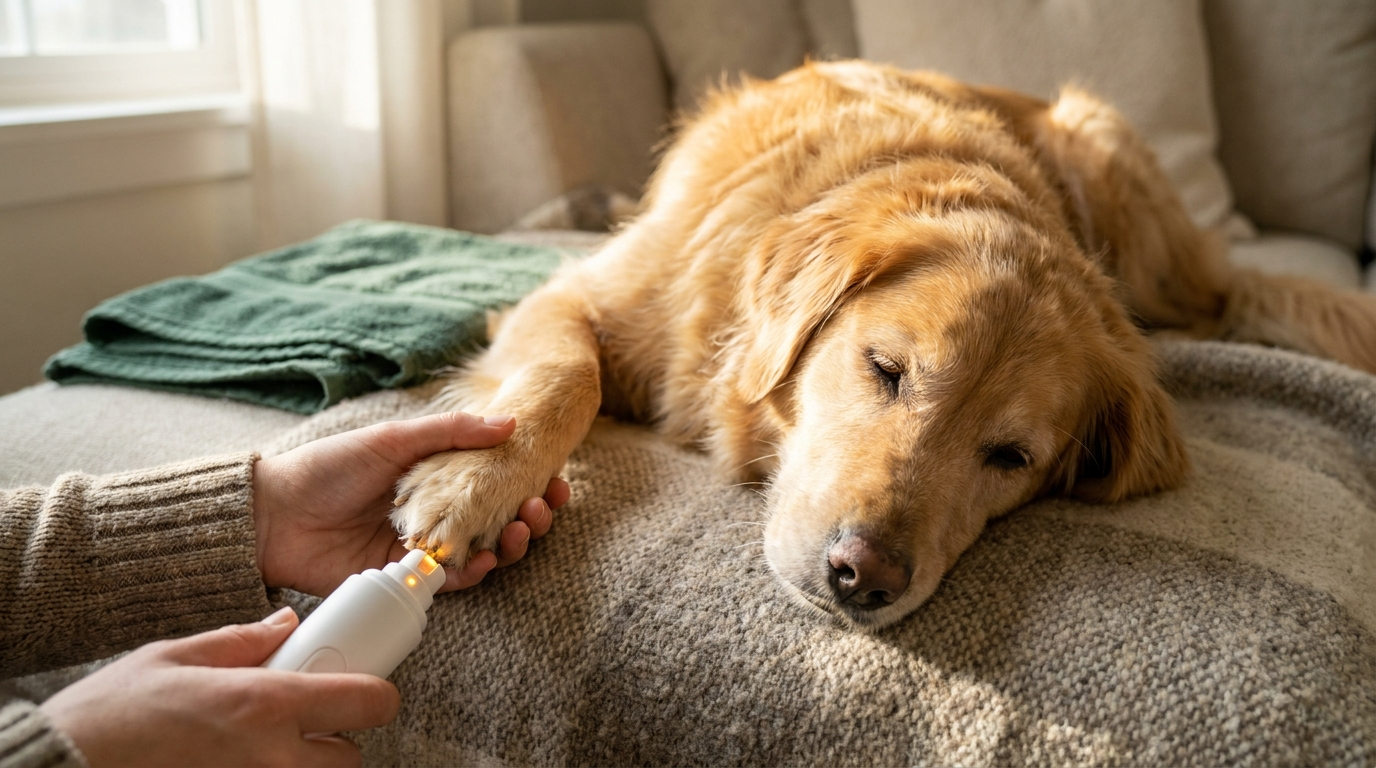
There's a specific kind of guilt that only dog owners know.
It's not the guilt of missing a walk, or running out of their favorite food. It's the guilt that hits the second you feel the clippers bite too deep: that half-second where your dog yelps, pulls back, and looks at you like you did something wrong.
You did everything you thought you were supposed to do. You held the paw gently. You went slow. You told him it was okay. And somehow, you still hit the quick.
If that's happened to you, you already know the rest of the story. The blood. The panicked scramble for something, anything, to stop it. The way your dog flinched the next time you so much as reached for his paw, weeks later, long after the nail had healed.
And the guilt that didn't heal nearly as fast.
If you felt that yelp in your chest, not just your ears — if the guilt hit you harder than the pain hit him — that's not a weakness. That's the instinct that makes you exactly the kind of owner who gets this right, once the tool stops getting it wrong.
That wasn't a mistake you made. It was a mistake built into the tool.
It was never a "you" problem
Somewhere along the way, most of us absorbed the same quiet belief: if your dog is scared of nail trims, it's because you didn't do it right, or because your dog is just "difficult." So you try to be gentler. Slower. More patient. And when it still goes wrong, the only explanation left standing is you must be bad at this.
You're not.
Every standard nail clipper (and, it turns out, most nail grinders too) asks you to do something that's genuinely difficult for anyone: guess exactly where the living part of the nail ends and the dead part begins, then cut or grind right up to that invisible line, with a tool that's actively working against you the entire time.
That second part is the piece nobody explains. It's not just the guessing. It's the tool itself.
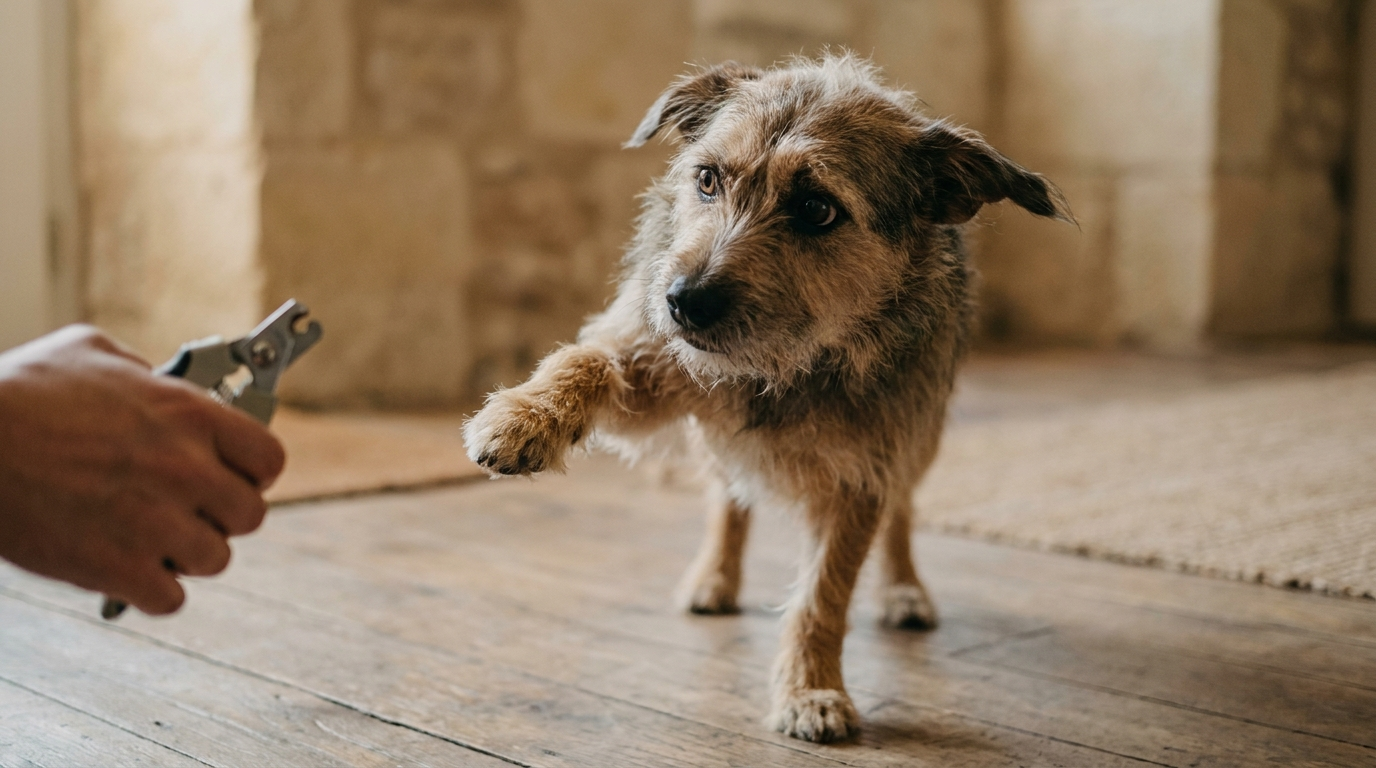
Why your dog runs from the "safer" option too
If you've already tried upgrading from clippers to a standard nail grinder, thinking that would fix it, and your dog still bolted, shook, or fought you just as hard, you're not imagining it, and you didn't buy the wrong brand.
Here's the uncomfortable truth about most nail grinders on the market: strip away the plastic shell, and what you're holding is a small power tool. The same motor whine. The same buzzing vibration transmitted straight through your dog's paw and up into a body that reads that exact combination of sound and vibration as one thing: danger.
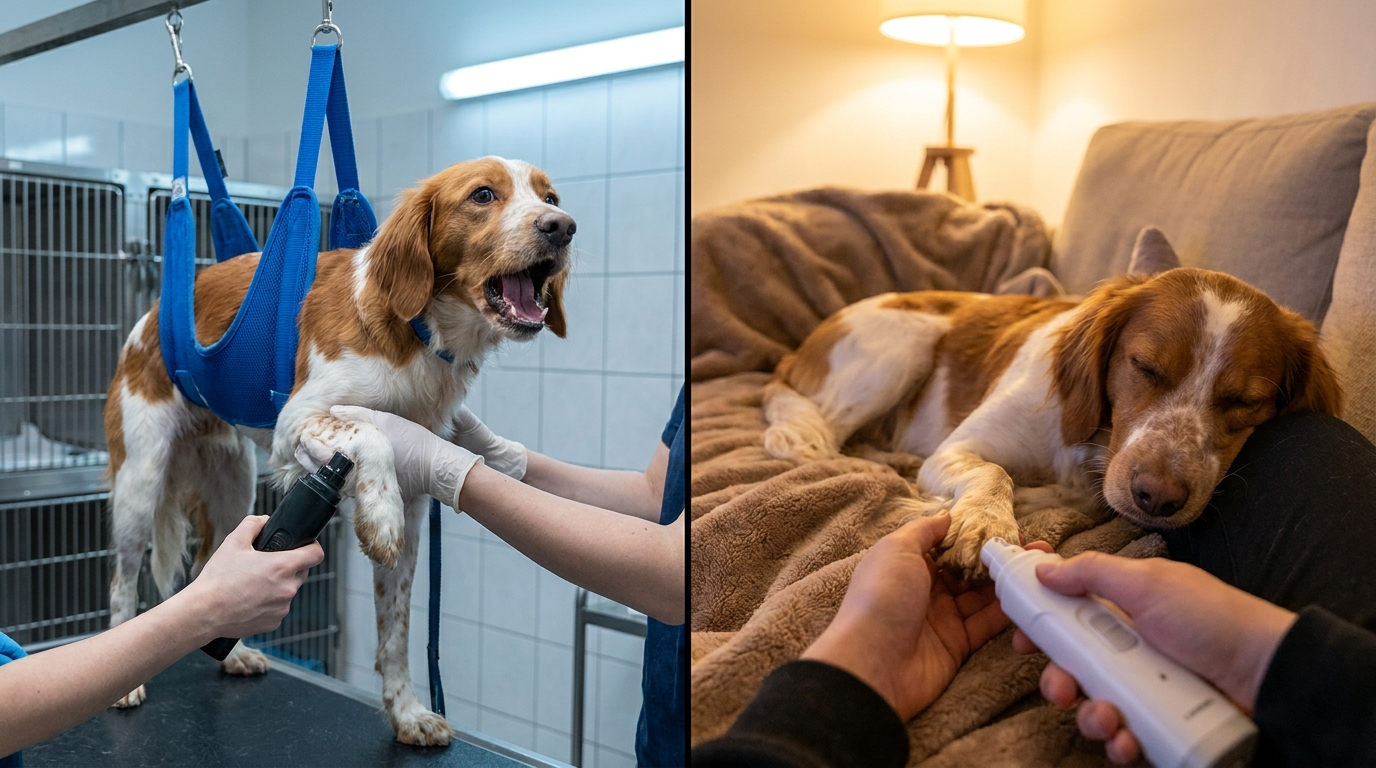
It's not a training issue. It's not a temperament issue. Trainers and veterinary behaviorists call it the "Noise-Triggered Fear Reflex" — the same hardwired instinct that makes dogs bolt from vacuum cleaners and hair clippers. Dogs are wired to read a buzzing, vibrating object pressed against their body as a threat, full stop. A grinder that's simply "quieter than a clipper" still isn't quiet enough to turn that instinct off. It just turns the volume down on the same alarm.
So you end up right back where you started: holding your dog down, both of you tense, dreading the next time nails need trimming, except now you've also spent money on a "solution" that didn't solve anything.
The two things that actually needed fixing
Once you see it laid out this way, the real problem stops looking mysterious. There were only ever two things working against you:
1. The noise and vibration itself. Your dog's nervous system reads it as danger before you've even touched a single nail — the Noise-Triggered Fear Reflex kicks in the moment the motor starts.
2. Not being able to see the quick. That turns every single trim into a guess, no matter how careful or experienced you are.
Every tool that came before tried to patch one of these, occasionally, halfway. None of them fixed both.
That's the entire idea behind LittleFurFolks QuietPaw.
It's built around a low-noise motor engineered to run under 45 decibels with dramatically reduced vibration: quieter than most household conversations, and smooth enough to sit below the threshold that triggers the Noise-Triggered Fear Reflex, instead of just being "quieter than the last one." And built into the head of the tool are dual LED lights that illuminate the nail from both sides as you grind, so you can actually see the quick, especially on dark nails, where most guessing (and most accidents) happen, instead of hoping your instincts are right.
Not a louder promise. A different mechanism entirely.
<45dB low-noise motor
Quieter than most household conversations, and low-vibration enough to stay below the Fear Reflex threshold.
Dual LED lights
Light up the nail from both sides so you can see the quick instead of guessing.
What that actually looks like in practice
The first time most owners try QuietPaw, the reaction isn't relief. It's suspicion. That's it? That's all it's doing?
There's no violent buzzing to brace for. No frantic pulling away the second it touches a paw. Just a low, steady hum quiet enough that some dogs genuinely don't react to it at all the first few times, including, for a few owners, dogs who dozed off mid-session.
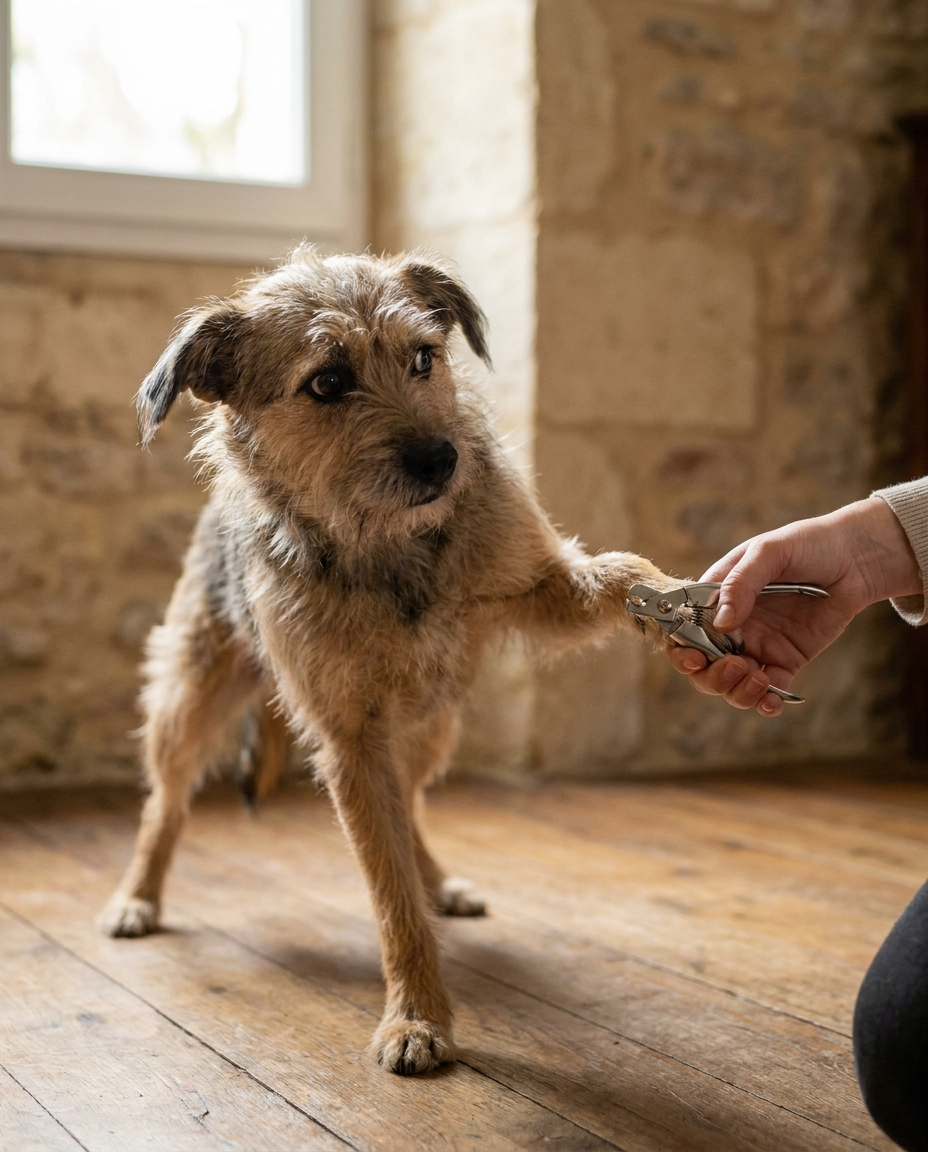
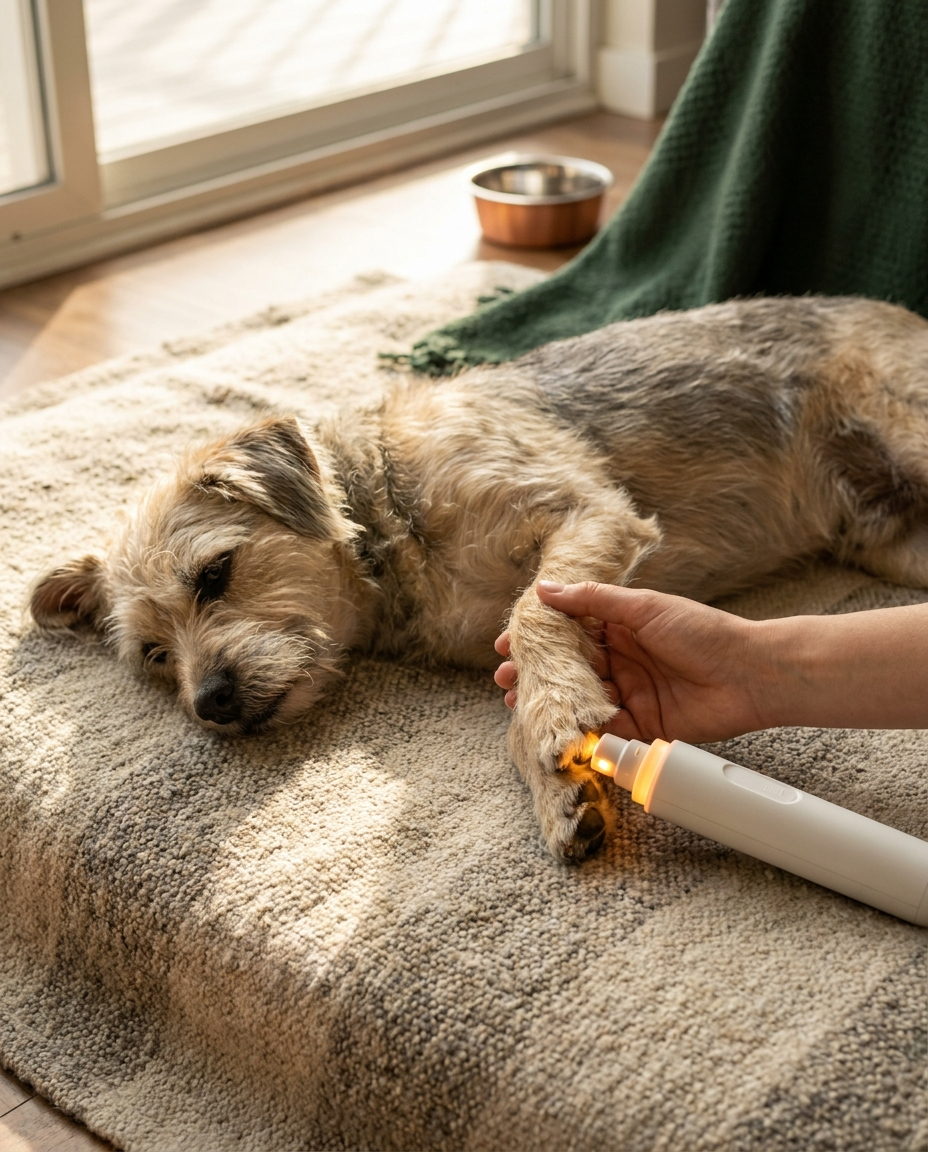
"It's very quiet, and my dog actually relaxes, sometimes he even dozes off! Our grooming sessions are peaceful now."
 Shelby M.
"I've always hated cutting my dog's nails... She stayed calm and seemed comfortable. It's a relief to see her pain-free."
 Michelle W.
"It's gentle and quiet... Nail grooming isn't traumatic anymore, and we're both much happier."
 Samantha M.
"It's basically silent, keeping us both calm, and I no longer worry about accidentally hurting him."
 Thomas C.
That last part is worth sitting with for a second, because it's really the whole point: it's not only that the trim goes smoother. It's that the fear, yours and his, starts to unwind, trim by trim, once the tool stops giving either of you a reason to brace for impact.
The exact moment to stop: no more guessing
This is the part that actually prevents the accident in the first place, so it's worth spelling out precisely instead of glossing over it.

Grind the pale tip until a small dark dot appears in the center: that's the edge of the quick. Stop there.

There's no color cue. Instead, watch the texture shift from dry and chalky to slightly softer and shinier. That shift is your stop sign.
In practice, that means the tool is telling you where to stop instead of you having to know in advance. You're not developing a sixth sense for it, and you're not relying on how many times you've done this before. You're watching for one specific, repeatable signal, and stopping the second you see it.

What you're probably already thinking
A few things worth answering directly, since you've probably already thought them:
"I already tried a 'quiet' grinder and it wasn't."
Fair, and that's exactly the gap QuietPaw was built to close. Under 45 decibels isn't a marketing description, it's a spec: engineered specifically to sit below the noise-and-vibration combination that triggers the Noise-Triggered Fear Reflex, not just "quieter than our last model."
"What if it's still too slow on thick nails?"
5 adjustable speeds (6,000 to 10,000 RPM) mean you're not stuck with one setting built for the average nail. For large or thick nails, remove the protective cover to grind faster and more thoroughly. You adjust to your dog's actual size and nail thickness instead of forcing it.
"Does it work for cats too?"
Yes. The side port and lower speed settings were built with smaller, more sensitive paws in mind, so one tool covers cats and other small pets as well, not just dogs.
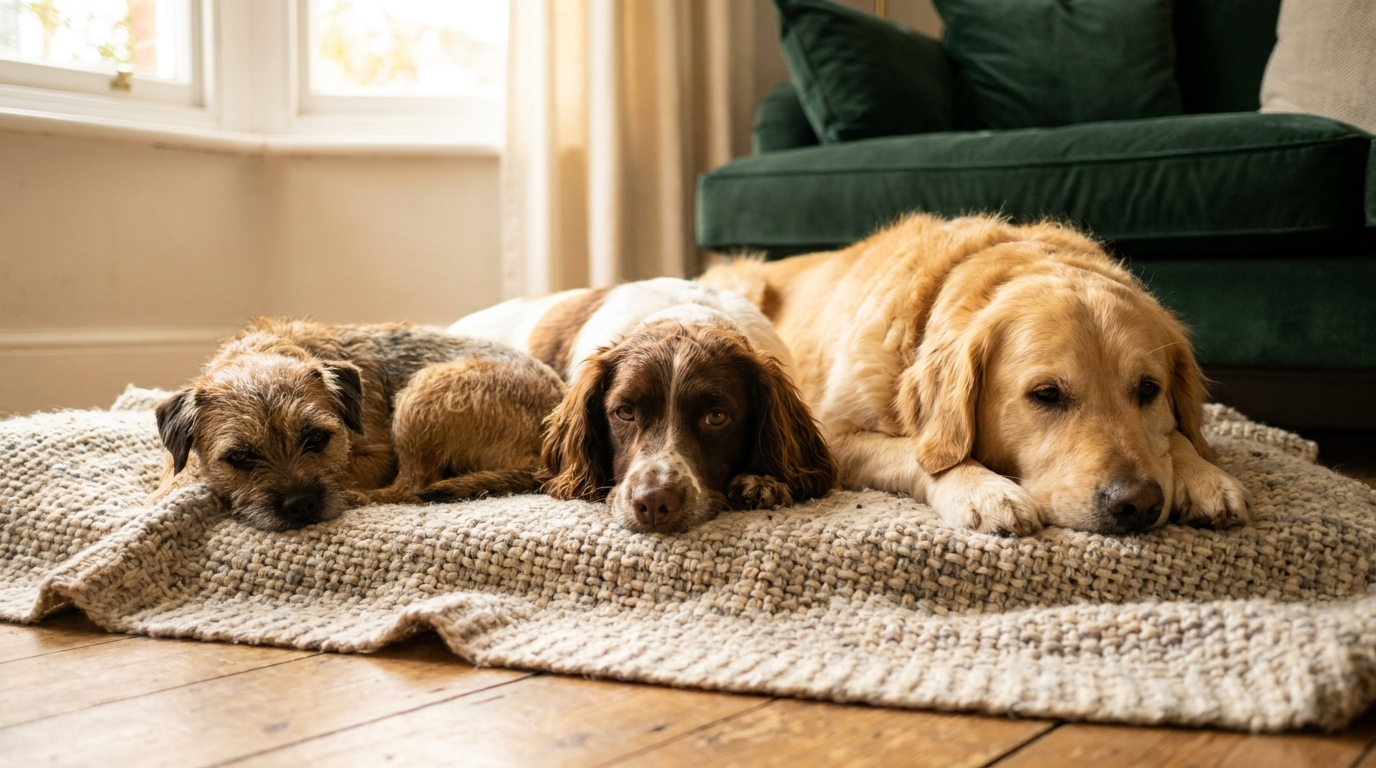
"What if my dog still won't tolerate it?"
Every QuietPaw is backed by a 60-day money-back guarantee. Try it at your own pace: most owners start with just one nail the first session, no full trim required, and if it's not a fit, it's not a loss.
"Will it die mid-trim?"
A full charge runs up to 8 hours of continuous use, enough for a full household's worth of paws, and it charges back up in about 2 hours over USB.
You don't actually need someone else to do this
You were never the type to outsource something you knew you should handle yourself. You just didn't have a tool that let you.
A lot of owners who've been burned once quietly decide the safer move is to just let a groomer or vet handle it going forward. That's a completely understandable instinct, but it's worth noticing what it actually costs: $10 to $60 a visit, every 3 to 4 weeks, for the rest of your dog's life. That's not a one-time expense. It's a recurring bill for something that, with the right tool, doesn't need to be outsourced at all. And nobody in the grooming industry is in a hurry for you to figure that out — every visit you book is another $30 to $60 they don't have to earn.
This isn't about being braver or more skilled than you already are. It's the same shift as everything else here: once the tool stops working against you, once you're not guessing and your dog isn't bracing, doing this yourself stops being a risk you're taking on, and just becomes something you do at home, calmly, on your own schedule.

The part that matters more than the nails
It's easy to think of this as a grooming tool. It isn't, really. It's the difference between a dog who braces every time you reach for his paw, and one who doesn't. That's because the thing that taught him to brace in the first place is gone.
Imagine what that actually feels like: reaching for his paw and having him just… stay. No flinch. No pulling away. Just trust — the kind that took one bad experience to break and that you've been quietly trying to rebuild ever since. A trim that ends with both of you calm, and the next one isn't something either of you has to dread.
That's real. Owners describe it in the reviews above. But here's the part worth sitting with: the next trim is coming whether you've solved this or not. And without this, you already know exactly how it goes — the same dread building for days, the same fight, the same look on his face when it's over. Except every time it goes badly, it gets a little harder the next time. Not a little easier. A single bad trim conditions a dog to fear the next one more, not less. That spiral doesn't flatten on its own. It deepens.
Long, ungroomed nails don't just click on the floor. Over time they change how a dog stands and walks, putting uneven pressure on joints that were never built to compensate for it — a slow problem that's far easier to prevent now than to undo later.
You already tried to be more careful. You already tried to be gentler. That was never the missing piece. The tool was.
60-Day Money-Back Guarantee
Try it at your dog's own pace. If it's not a fit, it's not a loss.
Try QuietPaw risk-free
No fighting, no flinching, no guessing where the quick is.
Get LittleFurFolks QuietPaw →Ships within 24 hours · Free shipping this week
This is a paid partnership between The Paw Report and LittleFurFolks.